








I still remember standing in a narrow alley in Kolkata’s North End, staring at a doorway my grandmother had described to me a hundred times from her kitchen in Toronto. The paint was different. The smell of mustard oil and marigold wasn’t. I hadn’t booked a tour. I hadn’t hired a guide. I had just shown up — and in doing so, I’d nearly missed everything that mattered.
- What Heritage Tourism Travel Actually Means
- What Is the Difference Between Heritage Tourism and Cultural Tourism?
- Is Heritage Tourism Exploitative? The Honest Answer
- How to Do Roots Travel Respectfully: A Practical Framework
- Sustainable Cultural Travel: Choosing Ethical Tour Operators
- How Can Travellers Support Local Communities — Not Just Observe Them?
- Avoiding Cultural Appropriation While Travelling: Practical Lines
- Community-Based Tourism: Real Examples That Work
- FAQ: Heritage Tourism Travel
- The Bottom Line: Travel With Roots, Walk With Respect
That trip taught me what heritage tourism travel actually is. Not a ticket. Not a checklist. A conversation — and like every real conversation, it can go wrong if you do all the talking.
Heritage tourism is one of the fastest-growing travel categories in the world, with the UNWTO estimating that cultural and heritage motivations influence over 40% of all international tourist arrivals. Yet for all its emotional power, it’s also one of the most easily exploited. Communities are reduced to backdrops. Living traditions get staged for cameras. Money flows to middlemen, not the people whose stories are being consumed.
This guide is for travellers who want to do it differently.
What Heritage Tourism Travel Actually Means
The term gets used loosely — sometimes interchangeably with “cultural tourism,” sometimes as a marketing label slapped onto any trip that involves old buildings and local food. So let’s be precise.


Heritage tourism is travel motivated by a desire to experience places, traditions, landscapes, and communities connected to your own — or to humanity’s — ancestral past. It can be deeply personal (tracing your family’s roots to a specific village) or broadly cultural (visiting the sites that shaped a civilisation you feel connected to).
The National Trust for Historic Preservation defines it simply as “travelling to experience the places, artifacts and activities that authentically represent the stories and people of the past and present.”
That word authentically is doing a lot of work. And it’s where most heritage travel either earns its meaning or loses it.
What Is the Difference Between Heritage Tourism and Cultural Tourism?
This is one of the most searched questions on this topic — and the distinction matters.

Cultural tourism is broad. It covers any travel that engages with the arts, customs, food, festivals, and lifestyle of a place. You can do cultural tourism in a city you’ve never had any connection to.
Heritage tourism is personal and historical. It’s rooted in lineage, ancestry, and a specific relationship between a traveller and a place. It asks: whose story is this, and what is my relationship to it?
The overlap is significant — but the ethical stakes in heritage tourism are higher, precisely because the emotional investment is deeper. When a traveller feels entitled to a culture because they share a bloodline with it, that entitlement can become its own form of extraction.
Is Heritage Tourism Exploitative? The Honest Answer
Yes — it can be. And the fact that you’re asking the question puts you ahead of most travellers.
Here’s how exploitation typically enters the picture:
- The zoo effect. Communities are positioned as living exhibits. Visitors observe; locals perform. No real exchange happens.
- Economic leakage. Tour operators, hotels, and booking platforms based outside the destination capture most of the spending. Local artisans, guides, and homestay hosts see a fraction.
- Narrative theft. Travellers arrive, take photographs, write blog posts, and leave — taking stories that aren’t entirely theirs to tell.
- Consent gaps. Sacred sites get visited. Rituals get photographed. No one asked whether that was welcome.
- Ancestry as a pass. Some travellers — particularly those tracing diaspora roots — assume shared heritage gives them automatic access and authority. It rarely does, and assuming so can damage communities already navigating complex relationships with their own past.
None of this makes heritage travel inherently wrong. It makes it inherently responsible — and that responsibility sits with the traveller.
How to Do Roots Travel Respectfully: A Practical Framework
1. Do the Research Before You Land
Respectful heritage tourism begins months before you board a plane. This isn’t about reading a Wikipedia page. It’s about understanding the living context of the place you’re entering.
- Research the post-colonial history of your destination. What happened to this community in the last 100 years? Who holds power now? Who doesn’t?
- Learn which sites are sacred, contested, or off-limits to outsiders — including those with ancestral connections.
- Identify community-led organisations at your destination: cultural centres, Indigenous tourism bodies, diaspora networks, local historians.
- Read work written by people from that community, not just about it. Novelists, journalists, oral historians.
The UNESCO Ethical Guidelines for Cultural Tourism are a useful baseline. So is the UNWTO’s framework for sustainable cultural tourism, which emphasises community consent and benefit-sharing as non-negotiables.
2. Follow the Money Intentionally
How you spend is as important as where you go. This is the single most direct way to ensure your travel benefits rather than extracts.
| Spending Category | Exploitative Default | Ethical Alternative |
|---|---|---|
| Accommodation | International hotel chain | Family-run guesthouse or community homestay |
| Guided tours | Big aggregator platform | Independent local guide or cultural cooperative |
| Food | Airport / tourist strip restaurants | Neighbourhood eateries, market vendors, community kitchens |
| Souvenirs | Airport gift shops | Direct from artisan, cooperative, or maker’s market |
| Photography | Photograph first, ask never | Ask first, share images with subjects afterwards |
| Cultural experiences | Packaged “authentic” shows | Community-run cultural centres, living history programmes |
When you book through community-based tourism platforms — organisations like Planeterra or local cooperatives — the economic benefit stays local. That’s not just ethical. It’s a better travel experience.
3. How to Research Your Ancestry Travel Destination
If you’re travelling to trace specific family roots, the research process goes deeper still.

Start with records, not romanticisation. Genealogical archives, church records, immigration documents, and oral family histories are your foundation. Organisations like FamilySearch, Ancestry.com, and regional national archives can help build an accurate picture before you arrive.
Connect before you go. Diaspora community groups on social media are remarkably generous with local knowledge. A Facebook group for descendants of a particular village in Ireland, West Africa, or South Asia will know things no guidebook does — including which local historians are worth meeting and which tourist experiences to skip.
Hire a local genealogical guide. In many countries, professional local researchers specialise in helping diaspora travellers trace records. They speak the language of local bureaucracies, know which archives are accessible, and can make introductions that no foreign visitor could arrange independently.
Manage your expectations actively. Your ancestral home may no longer exist. The community that remains may have complicated feelings about diaspora visitors. The stories you were told may be incomplete, romanticised, or — occasionally — wrong. Go prepared for that. Go anyway.
4. How to Visit Your Ancestral Homeland Respectfully
Showing up is just the beginning. How you behave once you’re there defines whether your presence is a gift or a burden to the community.
Listen before you speak. Especially if you’re diaspora returning to a community that stayed — people who lived through history you only read about. Their authority over that history exceeds yours, regardless of your bloodline.
Don’t perform belonging you haven’t earned. Wearing traditional dress, participating in ceremonies, or claiming insider status because of an ancestor’s bloodline needs to be invited, not assumed. Let the community extend that invitation; don’t claim it.
Leave something real. Buy from local artisans. Donate to community cultural preservation funds. Offer skills if you have relevant ones — photography, translation, archival research. Write about your experience in ways that credit and centre the community, not just your personal journey.
Ask about photography, always. A sacred site is still sacred if your great-grandmother prayed there. Photograph landscapes freely. Photograph people and ceremonial spaces only with explicit consent.
Sustainable Cultural Travel: Choosing Ethical Tour Operators
Not all heritage tourism infrastructure is created equal. Here’s how to evaluate operators before you book. You can read our complete Sustainable Travel Guide to start your your responsible journey.
What Good Looks Like
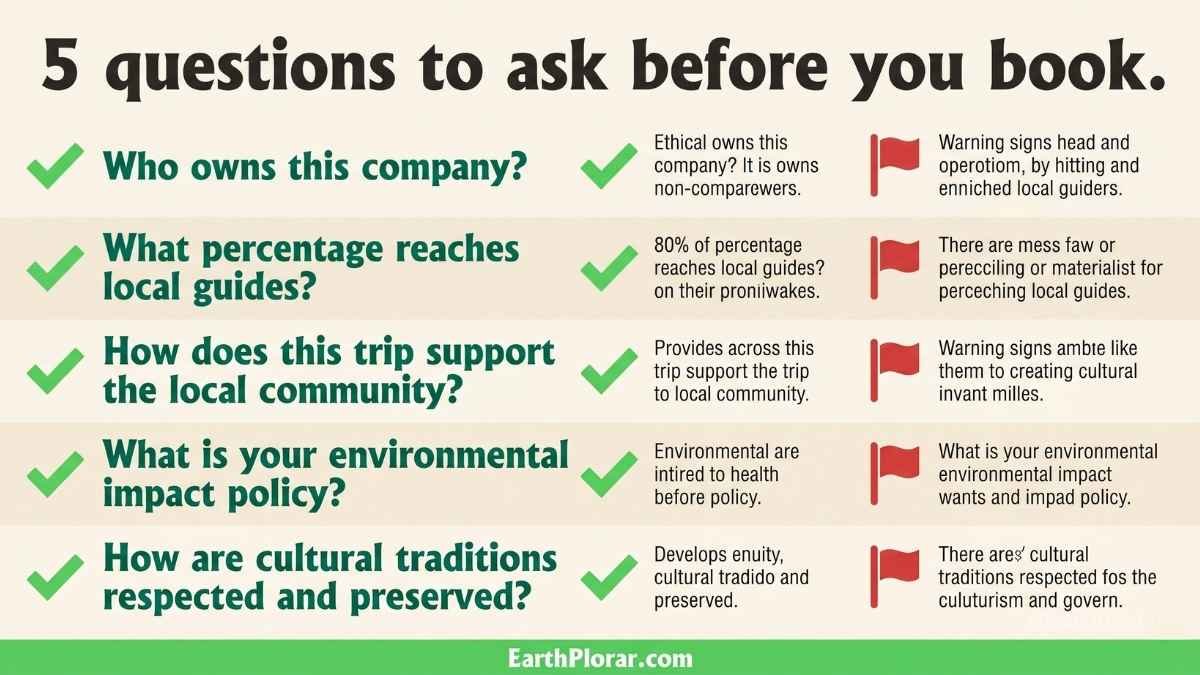
Community ownership. The best heritage travel experiences are run by the communities themselves — Indigenous tourism cooperatives, cultural trusts, diaspora-connected local guides. Look for this as your first filter.
Transparent economics. Ethical operators will tell you what percentage of your fee goes to local guides, community funds, and cultural preservation. If they can’t answer that question, that’s your answer.
Consent and cultural protocols. Reputable operators brief visitors on cultural expectations before arrival, not as an afterthought. They’ve built protocols around sacred sites, photography, and community interaction in consultation with local leaders.
Small group sizes. Large tour groups are structurally incompatible with authentic cultural exchange. They’re also more damaging to fragile heritage sites. Look for operators with caps of 8–12 people maximum for immersive experiences.
Comparison: Heritage Tourism Operator Models
| Operator Type | Economic Benefit to Community | Cultural Depth | Authenticity Risk | Best For |
|---|---|---|---|---|
| Community cooperative | Very high | Very high | Low | Diaspora returnees, deep immersion |
| Independent local guide | High | High | Low | Independent travellers, custom itineraries |
| NGO-affiliated programme | Medium-high | High | Low | First-time heritage travellers |
| Mid-size ethical tour company | Medium | Medium | Medium | Group travellers seeking structure |
| Large international operator | Low | Low-medium | High | Convenience-first travellers |
| DIY self-guided | Variable | Variable | Variable | Experienced heritage travellers with strong local networks |
How Can Travellers Support Local Communities — Not Just Observe Them?
This is the question that separates good heritage travel from great heritage travel. Observation alone is passive. Support is active, and it takes deliberate choices.
Extend your stay. The longer you stay in a community, the more your spending circulates locally — and the deeper the exchange becomes. Three days in a village does more for that community, and for you, than three days split across five cities.
Learn the language, even badly. Even basic greetings in the local language are a signal of respect. They communicate: I know this isn’t just a backdrop. I know you have a language I’m responsible for attempting.
Engage with living culture, not just historical culture. Heritage tourism too often fixates on the past — on ruins, on artifacts, on “traditional” ways of life. The living culture of a community — its contemporary artists, its current debates, its young people — is equally valid heritage. Seek it out.
Support cultural preservation directly. Many heritage sites and cultural centres rely on visitor donations and community patronage. Buying a local artisan’s work, paying the entrance fee to a community museum, or donating to an oral history archive are all direct acts of cultural sustainability.
Use your platform carefully. If you write, photograph, or make videos about your heritage travel — and many of us do — think critically about whose story you’re centring and how. Credit living sources. Link back to community organisations. Don’t reduce a living culture to your personal transformation narrative.
Avoiding Cultural Appropriation While Travelling: Practical Lines
There’s a spectrum between appreciation and appropriation, and it’s not always obvious where you’re standing. Here are some practical lines for heritage travellers.
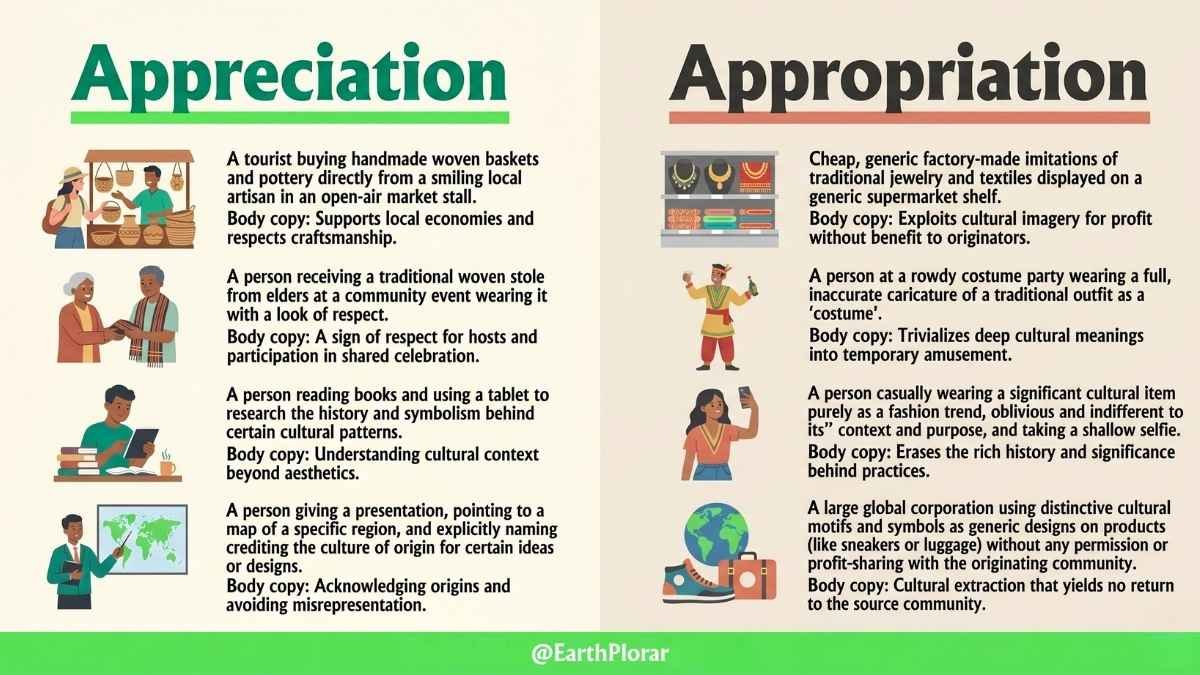
Appreciation looks like:
- Purchasing traditional crafts directly from the artisans who make them
- Wearing traditional clothing when explicitly invited to do so
- Participating in cultural practices when welcomed and briefed on their meaning
- Crediting and contextualising cultural elements when you share them
Appropriation looks like:
- Purchasing mass-produced imitations of sacred or traditional items
- Wearing traditional dress as costume without cultural context or invitation
- Participating in sacred practices as a tourist experience without understanding or consent
- Sharing cultural images and experiences as part of your personal brand without crediting their origins
The line is usually consent and context. When in doubt, ask. When you can’t ask, wait.
Community-Based Tourism: Real Examples That Work
The following models show what ethical heritage tourism looks like in practice.
The Maori tourism sector in Aotearoa New Zealand is one of the most developed examples of community-controlled heritage tourism in the world. Operators like Tamaki Maori Village are Maori-owned, employ Maori staff, and give visitors a culturally briefed, community-vetted experience. Revenue funds language preservation and community development. Tourism New Zealand’s Maori tourism framework is a useful reference model.
The Laos Community-Based Tourism Network connects travellers with village-level homestays and guides, ensuring that revenue stays within communities rather than flowing to external operators. It’s a practical example of how even deeply under-resourced communities can build heritage tourism infrastructure on their own terms.
Scotland’s Black History heritage trail initiatives, developed partly in response to diaspora African-Scottish travellers seeking ancestral connections, show how urban communities can build culturally honest heritage experiences that acknowledge complicated histories — including those of colonialism and transatlantic slavery — without sanitising them.
FAQ: Heritage Tourism Travel
What is the difference between heritage tourism and cultural tourism?
Heritage tourism is motivated by a personal or ancestral connection to a specific place, community, or historical period. Cultural tourism is broader — it encompasses travel to experience any culture, regardless of personal connection. Heritage tourism carries higher ethical stakes because personal attachment can create a sense of entitlement that, unchecked, becomes exploitative.
Is heritage tourism exploitative?
It can be, but it doesn’t have to be. Heritage tourism becomes exploitative when communities are treated as exhibits, economic benefits flow outside the destination, and cultural access is assumed rather than invited. Done well — with community involvement, ethical spending, and genuine reciprocity — heritage tourism is one of the most meaningful and sustainable forms of travel.
How do I research my ancestry before a heritage travel trip?
Start with genealogical archives (FamilySearch, Ancestry.com, regional national archives), then connect with diaspora community groups online for local knowledge. Consider hiring a local genealogical researcher at your destination. Read work written by people from that community — not just about it — and engage with living diaspora networks before you travel.
How can I tell if a heritage tour operator is ethical?
Look for community ownership or co-ownership; transparent economic disclosure (what percentage goes to local guides and community funds); clear cultural protocols around sacred sites and photography; and small group sizes. Ask directly: “Who owns this business, and who benefits from my booking?” Ethical operators answer that question readily.
What is community-based tourism and how is it different from regular heritage tourism?
Community-based tourism is a model in which the local community itself controls, manages, and benefits from tourism activity. It’s the structural gold standard for ethical heritage travel — not just ethical practice by individual travellers, but ethical architecture in the tourism industry itself. Examples include Indigenous tourism cooperatives, village-run homestay networks, and cultural trusts. Where regular heritage tourism can be ethical, community-based tourism is designed to be.
How do I avoid cultural appropriation while doing heritage travel?
The key markers are consent and context. Wear traditional clothing when explicitly invited; participate in cultural practices when welcomed and briefed; purchase crafts directly from artisans; credit cultural origins when sharing content. Appropriation typically involves taking cultural elements outside their context without consent, for personal aesthetic or commercial benefit.
The Bottom Line: Travel With Roots, Walk With Respect
Heritage tourism travel, at its best, is one of the most transformative things a human being can do. It connects you to a past that shaped you. It puts a face, a smell, a street corner to stories you grew up with. It gives you, in ways that are genuinely hard to describe, a fuller sense of who you are.
But it asks something of you in return.
Here are the five things to carry into every heritage journey:
- Research first, romanticise later. Know the real history — including the difficult parts — before you arrive.
- Follow the money intentionally. Spend in ways that benefit the community directly: homestays, local guides, artisans, community cooperatives.
- Listen more than you speak. Especially if you’re diaspora returning to a community that stayed.
- Ask before you photograph, participate, or claim. Consent is the foundation of respectful cultural engagement.
- Leave something real. Your presence should add something — economically, socially, or culturally — not just extract stories and photographs.
The alley in Kolkata taught me that showing up is the easy part. The harder part — the part that makes it mean something — is showing up ready to receive rather than take.
That’s roots travel. That’s the whole thing.
Ready to go deeper? Explore EarthPlorar’s Sustainable Travel Hub for guides on ethical wildlife tourism, low-impact adventure planning, and gear that travels as lightly as you do. And if pieces like this land with you, subscribe to the EarthPlorar newsletter — we send one genuinely useful thing, every week, no noise.
